
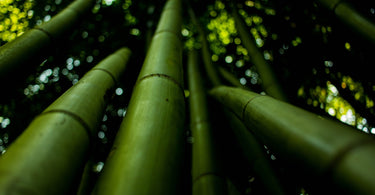
Not many plants have their own special day, but bamboo does. And for a good reason - there’s no other plant quite like it.
Quick and easy to grow, minimal resources needed, evergreen, great CO2 absorption. And on top of all that - the looks to match it. There’s a reason it’s the go-to material for bedding, eco towels, home and bathroom accessories of all sorts.
And in honour of this year's World Bamboo Day, we thought it was only fitting to give it a proper look - and coverage.
So, what exactly is it about bamboo that makes it so special?
What is World Bamboo Day?
World Bamboo Day is an global awareness day dedicated to bamboo, held every 18 September - modelled directly on Earth Day, according to the World Bamboo Organization's own description of it, and covering everything from environmental impact and sustainable construction to food, art, and local economies built around the plant.

But it’s so much more than just a date on the calendar. It's marked by events, workshops, and celebrations worldwide.
The organisation behind it, however, didn't just appear out of thin air overnight - there’s a fair bit of history behind it all. It's the result of nearly two decades of work before the Day even existed.
Here's how it actually came together:
- 1991 – An International Bamboo Workshop in Chiang Mai, Thailand, is where the idea for a global coordinating body for bamboo practitioners first takes shape.
- 1992 – That idea becomes the International Bamboo Association, formed at a congress in Japan.
- 2003–2004 – Susanne Lucas, alongside I.V. Ramanuja Rao and Karina Quintans, builds out the structure and mission that becomes the World Bamboo Organization, formalised at the 6th World Bamboo Congress in Delhi.
- 2005 – WBO is legally established as a US tax-exempt trade association, with Susanne Lucas as Executive Director.
- 2007 – Kamesh Salam, from Assam, India, becomes WBO President. 6. 2009 - On September 18th, at the 8th World Bamboo Congress in Bangkok, World Bamboo Day is officially declared under Salam's leadership, backed by Thailand's Royal Forestry Department.
- 2010–present – Michel Abadie takes over as President, and the World Bamboo Congress cycle continues today.
What Happens at a World Bamboo Congress?
A fair question. The name itself doesn’t really reveal much. But these are not trade shows.
Every congress runs on parallel tracks of peer-reviewed presentations, published afterwards as proceedings hundreds of pages long - covering biology and taxonomy, forestry and plantation management, material science, architecture and structural engineering, and community economic development.
The founding congress set the tone. Bangkok 2009 - the same event that declared World Bamboo Day - ran across nine tracks and produced 1,200 pages of proceedings under the theme "Bamboo, the Environment, and Climate Change."
Fifteen years on, the field's moved somewhere the 2009 delegates likely didn't expect. The most recent congress, Taiwan 2024, themed "Next Generation Bamboo: Solution, Innovation, and Design," included research on bamboo charcoal as a soil biochar, bamboo shoots as a dietary prebiotic, bamboo's antimicrobial compounds, and bamboo-derived biomass for advanced biofuels - material and food science, not the forestry-and-conservation focus the day started with.
The date and place for the next edition have already been set. June 2027, Rotterdam - the first World Bamboo Congress ever held in the Netherlands, and the first back in mainland Europe in over fifteen years.

The theme? It’s "Shaping Sustainable Futures."
How to Celebrate World Bamboo Day?
There's an actual, very real community behind the day. The World Bamboo Organization runs a dedicated free-to-join Facebook group where people share how they're marking it - events, plantings, workshops, all sorts.
Official logos are all available in full colour, single colour, and an alternate single-colour version, as downloadable EPS and PDF files - free for anyone to use on their own celebrations, no permission needed.
Past events give a sense of scale: 2027's congress alone is expected to double as one of the largest bamboo gatherings yet, and past World Bamboo Days have brought out everything from public talks and plantings to full-on festivals with food, music and craft markets, depending on where in the world you are.
But... Why Bamboo?
Still a completely grounded question. Years of deliberation, meetings, events, raising awareness… Why? What makes bamboo so special?
Quite a few things we’ve briefly touched upon already, actually.
-
Bamboo is not a tree: Bamboo is botanically a grass - the same family as wheat, rice, and your lawn - not a tree, despite outgrowing most of them several times over.
-
The growth record: Somewhere between 91cm (first measured at Kew Gardens, near London, in 1855) and 121cm (Kyoto, 1955) in a single 24-hour stretch - fast enough to watch happen, if you had the patience to sit and stare. The mechanism behind it is stranger than the number: unlike most plants, which grow by dividing new cells, bamboo's cells are already fully formed underground while it's still a shoot. Growth is those existing cells filling with water and stretching outward - closer to a sponge expanding than a plant growing in the way most people picture it.
-
It never grows twice: A cane reaches its full height and diameter in around 60 days, then stops - permanently. No other plant we know of works quite like that. A tree adds a little more height and girth every year for its entire life; a bamboo cane does all of its lifetime growing in two months, then simply exists at that size for the rest of its years.
-
It regrows without replanting: Cut a cane down and the same rhizome system underground simply sends up the next one, making it an incredibly sustainable resource. Whereas a tree, felled, has to be replanted from scratch. Harvesting doesn't damage the grove either; if anything, it can stimulate the growth of new shoots. That's part of why bamboo behaves more like a renewable crop than a one-time resource.
-
Evergreen: No dormant season, no bare winter months. Where deciduous planting goes bare for half the year, bamboo is doing something - screening, shading, holding soil - in every single one of them. It holds its leaves through winter the way very few temperate plants manage.
-
Hollow, segmented stems: Structurally unlike almost anything else that grows this tall, and part of why it's so light for its size. Each segment acts like an internal diaphragm, adding rigidity without adding weight. That combination - light, hollow, and still structurally sound - is exactly why it bends in strong wind and still doesn’t snap.
-
No taproot: The roots run shallow and wide instead of deep, with most feeding happening in the top 30cm or so of soil. That's exactly why bamboo is so effective at stabilising embankments and holding soil in place. It's also why bamboo copes reasonably well in a container, despite its reputation - there's no deep root system a pot is fighting against.

-
Synchronised flowering: Some species run on 40 to 75-year flowering cycles - and when the time comes, plants of the same species have been recorded flowering at once, on different continents, regardless of local climate. Botanists still don't fully understand what triggers it. Many species die shortly after flowering, which is the real reason bamboo is grown from divisions rather than seed - waiting decades for a viable one simply isn't practical.
-
Carbon capture: Project Drawdown puts bamboo production at roughly 2.03 tonnes of carbon sequestered per hectare, every year. That rate matches or beats many tree species outright, despite bamboo reaching maturity in a fraction of the time a tree needs. It's a real, measured figure - not a vague "good for the planet" claim standing in for one.
-
Diverse family: Somewhere between 1,000 and 1,500 documented species, depending on which count you trust. That range covers everything from low groundcover varieties to giants exceeding 40 metres tall. Few single plant families span that kind of extreme. · Scaffolding-ready: Bamboo scaffolding remains standard on high-rise construction sites across parts of East Asia - Hong Kong being the best-known example. This is an active practice. Skyscrapers still under construction today are wrapped in it, lashed together with nylon ties. It's faster to set up and lighter to transport than steel scaffolding, which is exactly why it hasn't been phased out.
How Bamboo Achieves Rapid Growth
It splits into two different behaviours, and it’s best to have a clear idea of what they are. Clumping varieties grow slowly in tight, well-behaved clusters.
Running varieties - commonly Phyllostachys species - spread through aggressive underground rhizomes that can travel several metres, and it's running bamboo behind almost every story about bamboo taking over a garden.
It's grown from a division, not seed - flowering cycles run 40 to 75 years depending on species, so waiting for a viable one isn't practical.
That division only grows underground at first; the cane you plant has already finished growing, and its job now is feeding the rhizome system beneath it. New shoots emerge the following spring and reach full height in a matter of weeks.
Conditions matter less than the reputation suggests. Most species want a few hours of direct sun, tolerate poor or clay soil given decent drainage, and are well-suited to UK gardens.
From Plant to Bamboo Fabric
And that incredible plant can also be turned into a fabric - and lend some of its incredible properties to actual household textiles.
Done well, it's incredibly soft in a way that's hard to match, breathable, and naturally moisture-wicking - closer to silk than to standard cotton against the skin.

It's part of why bamboo has become such a popular material for towels and bedding in the first place. But that bamboo towel can mean quite a few different things - so it all depends on what kind of fabric it is. Bamboo as a fabric comes in 5 main varieties:
-
Bamboo viscose/rayon: the most common by far - bamboo pulp dissolved in chemicals (typically sodium hydroxide and carbon disulphide) and regenerated into fibre. Soft, but the processing strips out bamboo's natural antibacterial properties, and it's what's usually hiding behind a plain "bamboo" label.
-
Bamboo modal: a more refined, more controlled version of viscose, using less chemical input and - at reputable producers - closed-loop methods that recover most of the solvent.
-
Bamboo lyocell: the cleanest regenerated version, with over 99% of the solvent captured and recycled. Also the least common and most expensive.
-
Bamboo linen: mechanically processed, no chemicals at all - low-impact and keeps bamboo's natural properties intact, but coarse, not soft, and rarely used for towels.
-
Bamboo-cotton blends: bamboo fibre combined with cotton, pairing bamboo's softness with cotton's structure and durability - where our own line of bamboo towels sits.
Bamboo FAQs
How fast does bamboo grow?
Up to 91cm in a single day, the figure Guinness World Records currently lists. A separately documented measurement - 121cm in 24 hours, recorded in Kyoto in 1955 - is actually higher, though it isn't the number most sources repeat.
How tall does bamboo grow?
It depends entirely on species. Many UK garden varieties stay between 3 and 8 metres, while the largest species worldwide, Dendrocalamus sinicus, can exceed 40 metres - taller than most mature trees.
Does bamboo grow in the UK?
Yes. Most species are fully hardy in British gardens, according to RHS guidance - it isn't marginal or borderline territory for it.
Does bamboo grow in shade?
Most species want at least a few hours of direct sun, but a smaller group of larger-leafed varieties will tolerate partial shade well.
Does bamboo grow well in pots?
Yes - and it's often the safer option for a UK garden specifically, since a container naturally limits the rhizome spread that causes problems in open ground.

How fast does bamboo spread?
Running varieties send rhizomes several metres underground before a new shoot ever breaks the surface, which is how it can cross a garden boundary long before anyone notices.
