
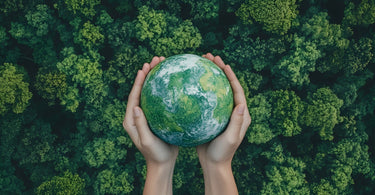
Most of us find out about these days the same way - a hashtag turns up on someone else's feed, we nod at it, and then forget it by Thursday.
World Sustainability Day falls on 28 October this year.
We celebrate it on the last Wednesday of October, and it's a day for thinking about how we live, buy and throw things away, with a sustainable future in mind. That's the short version.
The longer one is more interesting, mostly because the day is a little murkier than its name suggests.
When is World Sustainability Day?
There seems to be some confusion about that, and no wonder. The reason why you can’t seem to find a fixed date online is that… There is no fixed date.
Thankfully, the rule is very simple - it is always the last Wednesday of October. This year that's 28 October. Next year, it's 27 October.

And no, it isn't a public holiday. It’s business as usual, and nobody gets the day off (unfortunately!) - it's a prompt, not a bank holiday.
It’s easy to mix this day up with its better-known neighbours. Earth Day falls on 22 April and dates back to 1970.
World Environment Day, on 5 June, is led by the UN Environment Programme. Both have an organiser and a paper trail.
Who started it?
Another interesting bit. It’s not just the date that causes confusion. Nobody has pinned it down - and that’s a bit peculiar for a day with such significance.
Some sources trace it back to the US National Environmental Policy Act of 1969. The law is real; the connection to the day rests on pages repeating each other. Even the Environmental Alliance, which runs the worldsustainabilityday.org site, kind of… Skips the origin story.
Another claim credits the World Sustainability Organization and its founder, Paolo Bray. The organisation is real, and he founded it in 2008. But its own announcement of WSO Day doesn’t mention World Sustainability Day, and WSO Day is a separate event.
So, the real answer is - it’s quite unclear. It’s an informal observance, which also means nobody tells us how to mark it. That part is up to us.
But that’s beside the point. Just because the origin story is not exactly crystal clear, it doesn’t take anything away from its importance - especially in this modern age.
What to Do on the Day
You don’t need a big gesture. One small change that sticks does more than ten that don’t.
-
At home - pick one product you own that calls itself eco-friendly and check what’s behind the claim. Then keep what you’ve got for longer. An old towel still has a few lives left - perhaps repurposing old towels is an option, or you could learn how to make towels soft again.
-
At work - choose one thing the office throws away regularly and find out where it goes. Often nobody knows, and asking is the first step.
-
In the community - look for a local repair café or swap event. Fixing or passing something on is the simplest form of sustainability there is.
Sustainability in One Sentence
The most-quoted definition comes from the UN’s Brundtland Commission in 1987 - meeting the needs of the present without compromising the ability of future generations to meet their own needs.

Simple enough. But it’s really about one thing, and one thing only - time.
Not logos, not leaf icons.
Whether what we use today leaves anything for later. It’s a long-term idea, which is exactly why a single day can only ever be a starting point.
If you want the longer story, we’ve covered the history of sustainability as an idea, from the first forestry laws to Earth Day.
Where the Waste Starts
For an average person, the answer is at home.
According to WRAP’s Textiles Market Situation Report 2024, 49% of used textiles in the UK end up in residual waste - around 711,000 tonnes. That figure covers textiles in general, not towels specifically. It still shows where a lot of what we buy ends up.
The obvious fix is to buy something labelled sustainable. But that’s where it also gets a bit tricky - a label means very little without a name behind it.
The desire to make better choices is a great start, but it’s not enough. Decisions have to be informed to be better.
Three Questions Before You Trust a Label
Ask three questions. They take a minute and they cut through most of the noise.
-
Who certifies it? Look for a named sustainable standard, not a general claim. A leaf on the packaging isn’t a standard.
-
What does it cover? Some labels only cover the raw fibre. GOTS goes further - it covers every production step from fibre processing and spinning through to manufacturing and trading, with annual on-site audits, and every company in the chain has to be certified for a product to carry the label.
-
How long will it last? Weight and construction matter here. A heavyweight towel that holds up for years beats a lightweight one you replace every other season, whatever the label says.
One caveat. A certification tells you how something was made. It doesn’t tell you whether you needed it, and no label makes a fourth towel you never use sustainable.
So, when you look for a set of quality eco towels, do your due diligence to make sure they earn that name.
Our Commitment
Our organic cotton beach towel is that kind of product - it’s 100% GOTS-certified organic cotton at 550 GSM and 90 x 180cm. So are our organic cotton ribbed towels, also 100% GOTS-certified, at a heavyweight 650 GSM and machine washable. Our bamboo towels are a bamboo and cotton blend at 580 GSM, for anyone after something softer.

The bathroom floor is worth a look too. A stone bath mat is made of diatomite - a porous rock that pulls water in and lets it go again - which is a different proposition from a fabric mat that tends to stay damp.
The Other 364 Days
One day won't change much on its own. But it's a good enough excuse to open the bathroom cupboard, check what's in there and ask where it'll end up.
It’s all about individual efforts stacking up, choosing sustainable practices and creating a snowball effect - only this time, the snowball may be the stopping force for environmental changes nobody should want to see.
